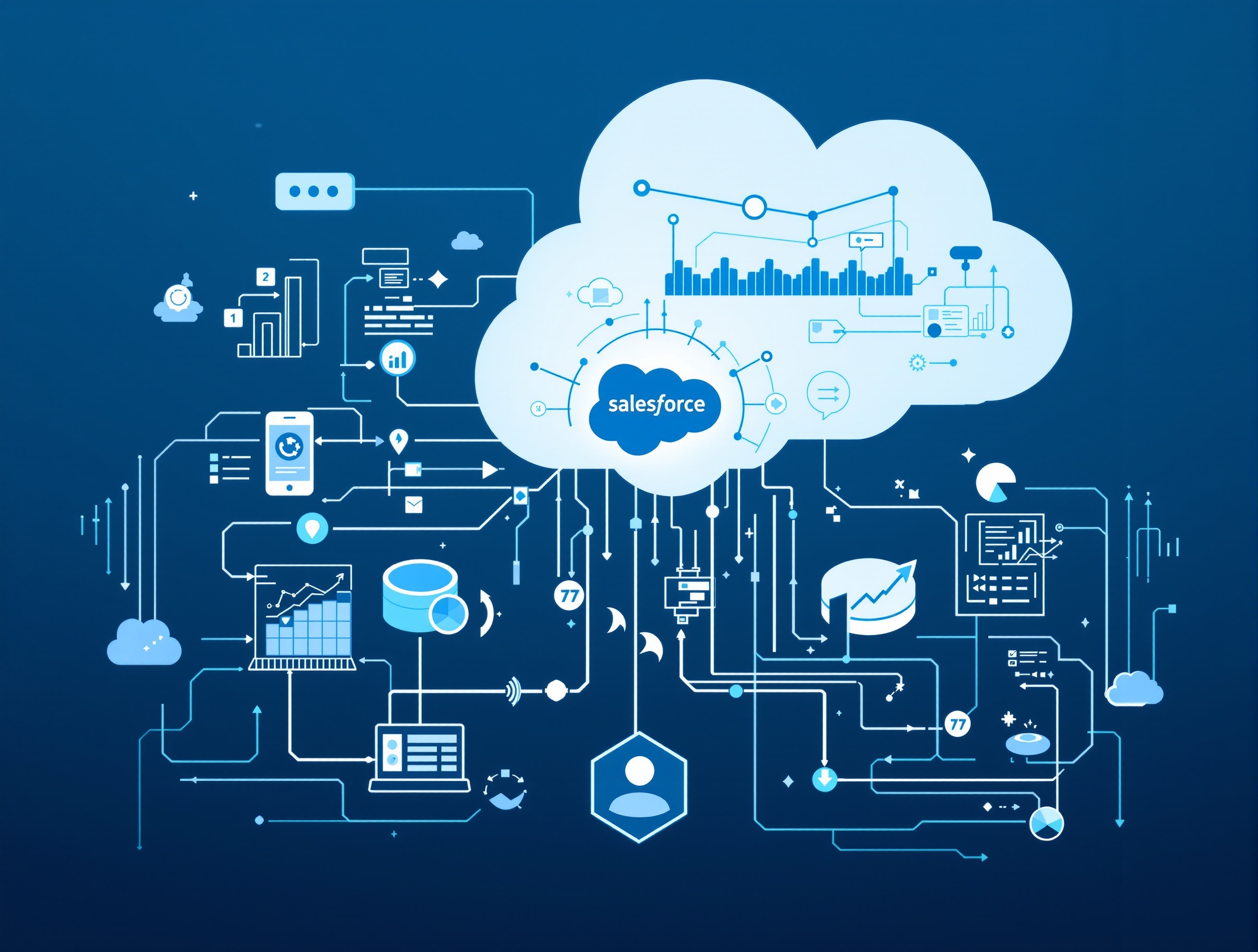
Le Guide Ultime pour l'Implémentation de Salesforce Data Cloud
Apprenez à implémenter avec succès Salesforce Data Cloud avec notre guide complet couvrant l'évaluation, les phases d'implémentation, les bonnes pratiques et les métriques de succès.
Introduction to Salesforce Data Cloud
Salesforce Data Cloud represents a paradigm shift in how organizations manage and leverage their customer data. By providing a unified platform for data integration, harmonization, and activation, Data Cloud enables businesses to create a comprehensive 360-degree view of their customers.
The Assessment Phase
Before diving into implementation, it's crucial to assess your organization's current data landscape. This includes:
- Identifying all data sources across your organization
- Evaluating data quality and completeness
- Understanding business requirements and use cases
- Defining success metrics and KPIs
Implementation Strategy
A successful Data Cloud implementation follows a phased approach:
Phase 1: Foundation
Set up your Data Cloud instance, configure data spaces, and establish governance policies. This phase typically takes 2-4 weeks.
Phase 2: Data Integration
Connect your data sources using pre-built connectors or custom integrations. Focus on high-priority data sources first to demonstrate quick wins.
Phase 3: Data Harmonization
Create unified profiles by mapping fields, resolving identities, and establishing relationships between data objects.
Phase 4: Activation
Build segments, create calculated insights, and activate your data across Salesforce clouds and external platforms.
Best Practices
- Start with a pilot: Begin with a specific use case to prove value before scaling
- Prioritize data quality: Clean data is essential for successful implementation
- Involve stakeholders: Ensure buy-in from business users, IT, and leadership
- Plan for scale: Design your data model with future growth in mind
Success Metrics
Track these KPIs to measure your Data Cloud implementation success:
- Data source coverage (% of critical sources integrated)
- Profile match rate (% of records successfully unified)
- Time to insight (how quickly teams can access data)
- User adoption rate across teams
- ROI through improved campaign performance or operational efficiency
Conclusion
Implementing Salesforce Data Cloud is a transformative journey that requires careful planning, execution, and ongoing optimization. By following this guide and leveraging expert support, your organization can unlock the full potential of your customer data.
Si ça ressemble à votre CRM, regardons-le ensemble.
Trente minutes, sans slides, sans pitch commercial. Vous repartez avec un diagnostic dans tous les cas.